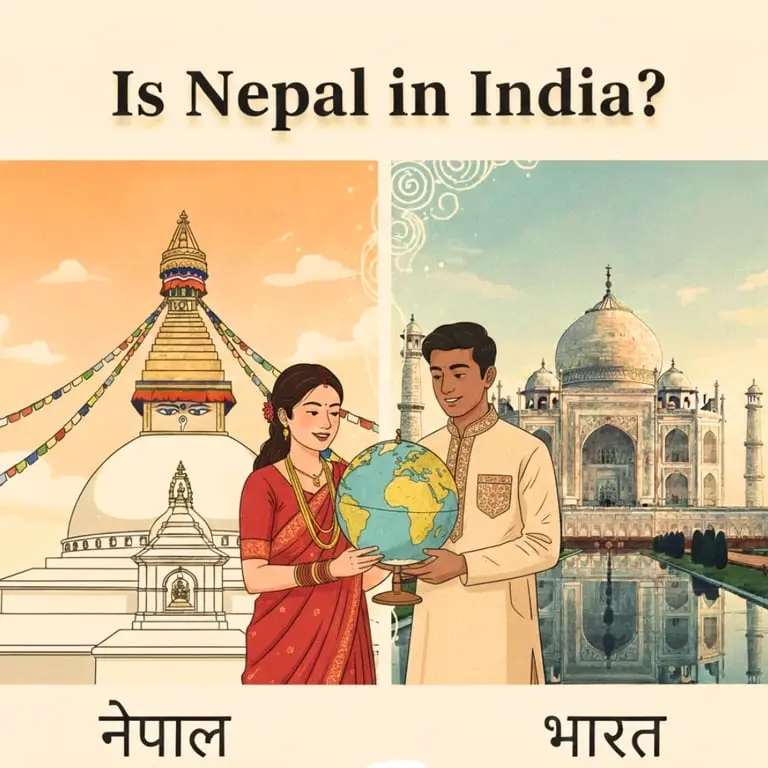
Have you ever found yourself wondering, "Is Nepal in India?" if you have, you're not alone. This confusion is a common misconception that persists around the world. Due to the similar geography and culture of the two countries, Nepal is often mistaken for a part of India.
But don't worry, in this blog, we’ll have a more in-depth look at the link between India and Nepal, and we’ll clear any speculations along the way. This speculation on Nepal’s origin stems from the lack of knowledge about the country. And spoiler alert: Nepal is not in India nor is it in China! Where actually is Nepal?
Nepal is a landlocked country located in South Asia, nestled in the heart of the Himalayas. On three sides, the nation is bordered by India; on the other, it shares a border with Tibet, China’s Autonomous Region. It lies between latitudes 26° and 31° N, and longitudes 80° and 89° E.
The border between Nepal and India is quite extensive, stretching over 1,751 kilometers, allowing free movement between the nations, whereas its border with China is much restricted. It's about 1,414 kilometers with the Himalayas acting as a natural barrier. Nepal’s geopolitical location balances its connections with India and China. It also lies in a seismically active tectonic plate zone, making it more prone to earthquakes.
No. Nepal is not and never was a part of India. Nepal is recognized as an independent country, a member of the United Nations, and a participant in various global organizations. This recognition further solidifies Nepal's position on the world stage as an autonomous entity.
Diplomatic relations with countries around the world reinforce its sovereignty and independence. Now, if you see anyone wondering, "Is Nepal in China or India?" You know your answer. It's neither! Nepal stands alone as its own sovereign state.
Why does the myth "Nepal is in India" persist? The confusion often stems from geographical proximity and cultural similarities. Many people think Nepal is a part of India due to the open border shared between the two countries. The border is often a busy area with bustling trade activities.
Citizens don’t need passports or visas to move between the two countries, which might create confusions to foreigners about them being a single unified region. Beyond the tangible exchanges, there's a cultural and social interchange that enriches both sides of the border. Throughout history, Nepal and India have influenced each other in numerous ways.
The flow of ideas, art, language, and religion has enriched both cultures, with Buddhism and Hinduism playing pivotal roles in shaping societal norms and practices in both countries. Festivals, rituals, and customs often overlap, reflecting the shared cultural heritage. Due to this, it is also possible for outsiders to believe they are part of the same country.
Geographically, Nepal is bounded by India on three sides, which makes it more confusing for anyone who is unfamiliar with South Asia. Another reason for this confusion comes from incorrect media representation. There have been multiple Indian films made depicting the life of Gautam Buddha; they don't specify the relevance of Nepal to his life or, in some cases, even imply that Buddha was born in India.
An example for this is Nikkhil Advani’s ‘Chadni Chowk to China’, which got banned in Nepal due to a reference made in the film where India was referred to as the birthplace of Gautam Buddha, because Buddha was born in Nepal and Buddhism in Nepal is an important part of this fact. Nepal barely gets enough representation on the international scale as it is, and things like these make it harder for Nepali heritage to get highlighted globally. Inaccurate information presented in popular films frequently gets accepted as the truth by viewers who are not familiar with South Asia.
Due to this, many people think that Nepal is a part of India or has the same historical identity as India. Misinformation on social media and limited knowledge on the south asian region also adds to this issue. However, it's crucial to recognize the distinctions that set Nepal apart as an independent country.
Nepal is known for its stunning mountain landscapes, breathtaking hills, and vast plains. We can divide Nepal into three different geographical parts: the Himal, the Pahad, and terai. Nepal is a geographically rich country in South Asia because of its topography, which influences the nation's culture, lifestyle, and economy.
The Himalaya, or more popularly known as the Himalayas/Mountains, are dominated by magnificent snow-capped mountains and glacial terrains, including the majestic Mount Everest, the world's tallest peak. The Himalayas are a source of vital resources, including freshwater from glacial melts, supporting agriculture and livelihoods in the region.
The ecological significance of the Himalayas extends beyond Nepal, affecting climate and weather patterns across South Asia. Communities like Sherpa and Tamang are the main residents of this area. The culture of the Himalayan region is highly shaped by its environment, traditions, and Tibetan influence. People here mostly follow Buddhism, with monasteries being present in every village.
Nepal declared independence from the British Empire in 1923, long before India gained its independence in 1947. This historical journey to independence underscores Nepal's status as a separate nation, distinct from its neighbors. The country's monarchy played a crucial role in maintaining its sovereignty during colonial times.
The transition to a republic in 2008 marked a significant milestone in Nepal's political evolution, reflecting the aspirations of its people for a more democratic and inclusive society. The country's constitution, adopted in 2015, enshrines its commitment to democracy, secularism, and federalism. These political developments highlight Nepal's unique path and identity on the global stage.
The movement of goods and services between these two nations is a testament to their economic interdependence. Internationally, Nepal is recognized as an independent country, a member of the United Nations, and a participant in various global organizations.
This recognition further solidifies Nepal's position on the world stage as an autonomous entity. Diplomatic relations with countries around the world reinforce its sovereignty and independence.
Nepal's active participation in international forums, such as the South Asian Association for Regional Cooperation (SAARC) and the United Nations, demonstrates its commitment to global peace and development.
The country's contributions to peacekeeping missions are well-regarded, enhancing its reputation as a responsible member of the international community. This global presence affirms Nepal's distinct identity and role in world affairs.
Culturally, Nepal has its own distinct identity, shaped by its unique history, geography, and traditions. It's important to note that Nepal is an independent country with its own government, culture, and identity.
| Classification | Nepal | India |
| Political Status | Independent sovereign nation | Independent sovereign nation |
| Government Type | Federal democratic republic | Federal democratic republic |
| Capital | Kathmandu | New Delhi |
| Independence | Never colonized; maintained sovereignty throughout history | Gained independence from British rule on August 15, 1947 |
| Republic Since | 2008 (was a monarchy before) | 1950 |
| Area | 147,516 km² (small in size ) | 3.287 million km² (7th largest country in the world) |
| Geography | Landlocked, mountainous (Himalayas) | Diverse: beaches, deserts, plains, mountains |
| Highest Point | Mount Everest (8,848.86 m) - the world's highest | Kanchenjunga (8,586 m) - world's 3rd highest |
| Official Language(s) | Nepali | Hindi and English (plus 22 recognized regional languages) |
| Currency | Nepalese Rupee (NPR) | Indian Rupee (INR) |
| National Flag | Two stacked triangles (the only non-rectangular flag in the world) | Rectangular tricolor with Ashoka Chakra |
| Flag Colors | Crimson red with blue borders | Saffron, white, and green with a blue wheel |
| Religion | Secular state (majority Hindu with Buddhist minority) | Secular state (majority Hindu with significant Muslim, Christian, Sikh minorities) |
| Border Length | Shares 1,850 km open border with India | Shares borders with 7 countries, including Nepal |
| UN Membership | Since 1955 | Since 1945 (founding member) |
| Administrative Divisions | 7 provinces | 28 states and 8 union territories |
Economically, the two countries have maintained strong trade relations, with India being one of Nepal's largest trading partners. This economic interdependence is vital for Nepal, as it relies on India for access to ports and markets. Collaborative projects in energy, infrastructure, and tourism further strengthen this economic bond.
Remittances from Nepalese workers in India also play a crucial role in Nepal's economy, supporting families and contributing to national income. Despite challenges, such as trade imbalances and border disputes, the economic ties between Nepal and India remain robust. Efforts to enhance trade facilitation and address barriers are ongoing, aimed at maximizing the potential of this partnership.
Politically, Nepal and India have collaborated on various fronts, fostering a partnership that benefits both nations. Diplomatic relations are characterized by high-level visits, agreements on mutual interests, and cooperation in regional forums. The two countries work together on issues such as security, environmental conservation, and disaster management.
The influence of Indian cinema, music, and literature is also evident in Nepal, where Bollywood films and songs are immensely popular. This cultural exchange extends to cuisine, with many dishes reflecting a blend of Nepalese and Indian flavors. Such interactions have fostered a sense of familiarity and kinship between the two nations, enhancing mutual understanding and respect.
On the flip side, to the north lies China, another of Nepal's neighbors. The two countries share a border that runs along the Himalayan range. This boundary, although not as extensive as the one with India, plays a crucial role in Nepal's geographical and political landscape. So, whether you're wondering, "Is Nepal in China or India?" The answer is neither because Nepal stands alone as its own sovereign state.
Nepal isn't just one culture; it's like 125 cultures put into one small country. You've got Sherpas in the mountains, Tharus in the southern plains, Newars in the Kathmandu Valley, and so many more groups, each doing their own thing. It's wild. You can drive for two hours and feel like you've entered a completely different country.
Living in Nepal means living with the Himalayas. They're not just pretty backdrops for Instagram photos; they're sacred. They shape the weather, the culture, and the way people think about their place in the world. There's this deep respect for nature, this understanding that humans are small and the mountains are eternal.
When Nepalis greet you with "Namaste" and press their palms together, they mean it because greetings in Nepal are not just a simple hello. It translates roughly to "the divine in me honors the divine in you." It's respect, it's warmth, it's genuine.
And languages? Forget about it. Sure, Nepali is what everyone learns in school, but people speak 123 different languages across the country. Your neighbor might speak Tamang, the shopkeeper speaks Newari, and your friend from the Terai speaks Maithili. It's a linguist's dream. The languages of Nepal are diverse and beautiful.
Nepali people are known for being incredibly welcoming. You show up as a stranger, and within an hour, you're being fed, offered tea, and invited to someone's cousin's wedding next month. This generosity of spirit's hard to describe until you experience it.
Nepal and India are two completely separate countries. Nepal has its own passport, its own seat at the United Nations, and its own government making its own decisions. When you cross from India into Nepal, you're entering a different nation, even if the border feels casual and the faces look familiar.
What really sets Nepal apart is its story. While India fought for independence from British rule, Nepal was never colonized by anyone. It kept its independence through smart diplomacy and tough mountain geography.
Nepal's active participation in international forums, such as the South Asian Association for Regional Cooperation (SAARC) and the United Nations, demonstrates its commitment to global peace and development. The country's contributions to peacekeeping missions are well-regarded, enhancing its reputation as a responsible member of the international community. This global presence affirms Nepal's distinct identity and role in world affairs.
Culturally, Nepal has its own distinct identity, shaped by its unique history, geography, and traditions. While similarities with India exist, Nepalese culture is characterized by its diversity and richness. The pride in national symbols, such as the flag, anthem, and cultural icons, reflects a strong sense of national identity.
So is Nepal in India? Not even close. Nepal is Nepal, a sovereign nation with its own government, its own flag flying at the UN, its own currency jingling in people's pockets. It's got its own story, its own struggles, its own victories.
Sure, Nepal and India are close. They're neighbors, they trade, they share cultural ties going back millennia. But that's just what good neighbors do. Nepal stands on its own two feet, proudly independent, right there in the heart of the Himalayas.
It's a small country, yeah, but it's got the tallest mountains, some of the friendliest people, and a cultural richness that punches way above its weight. Nepal is its own place, with its own identity, and that's exactly how it should be.
In conclusion, while Nepal and India share many ties that bind them closely, it's essential to appreciate and respect Nepal's unique identity and sovereignty. By understanding the geographical and cultural nuances, we can debunk the myth that Nepal is part of India and celebrate the rich tapestry of cultures that make up this incredible nation.
Next time you look at a map and wonder about Nepal's location, remember: Nepal is not in India or China, it's an extraordinary country all on its own. Recognizing Nepal's contributions to global culture, history, and politics is a step towards appreciating its role in the world. Embracing Nepal's uniqueness is not only about correcting misconceptions but also about celebrating the diversity and richness it brings to the global community.
Yes, Buddha was born in Nepal in the Shakya Kingdom in Lumbini of Rupandehi district, which lies in present-day Nepal. Lumbini is a UNESCO World Heritage Site and an important pilgrimage destination for Buddhists from around the world.
Mount Everest sits right in the heart of the Himalayas, straddling the border between Nepal and Tibet (China). The south side of the Everest lies within the Nepal border, which is also the route most trekkers and climbers take when heading to Everest Base Camp. If you’re exploring Nepal, you’re already closer to the world’s tallest peak than you might think! The North side of Everest is accessible from China.
Nepal is geographically closer to India, but shares its borders with both India and China. In fact, most of Nepal’s southern, eastern, and western borders touch India, while only the northern edge meets China (Tibet). So if you're traveling in and out of Nepal, you’ll find far more access points and cultural ties with India than with China.
Nepal is a sovereign, independent nation and not a part of India. Historically, Nepal was never a part of India, even when India was colonized.
Yes, Nepal is older than modern India because Nepal became a unified kingdom in 1768 under King Prithvi Narayan Shah, whereas India became a modern nation-state in 1947 following its independence.