
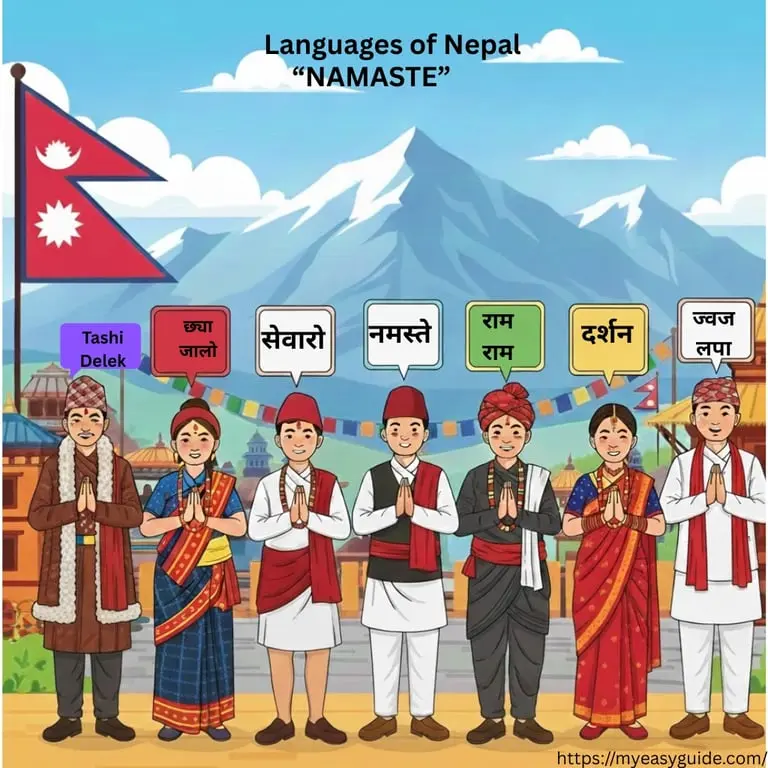
From the warm jungles of the lowlands to some of the tallest mountains on Earth, Nepal is a country of striking extremes, from the hottest of plains to the coldest alpine highlands. And just like its landscapes, its languages tell stories of deep history, culture, and connection. Curious about what language people speak in Nepal? Do you also want to learn the greetings of Nepal, or at least know how to say hello in Nepal? You’re about to step into a vibrant mosaic of voices and traditions.
Nepal is a country where towering peaks meet rich cultural diversity, and just as its landscapes vary from the tropical plains to the snowcapped mountains, the diversity becomes diverse and goes wider. With the beautiful linguistic landscape that is equally diverse and fascinating, languages become more than just a medium to communicate but also a way to connect.
If you’ve ever wondered what language people speak in this beautiful Himalayan nation, then you are about to discover a land that is far more complex and beautiful than you might imagine.
If you're planning a trip to Nepal or just curious about this beautiful Himalayan country, you might be wondering: what language do people speak there?
Nepali is the official language of Nepal. Spoken by the majority of the population. Nepali isn't just the official language on paper. It's the everyday language that brings Nepal's incredibly diverse population together. With over 120 ethnic groups calling Nepal home, Nepali serves as the common ground and a medium to connect that helps everyone connect, no matter which valley or mountain village they're from.
Nepali belongs to the Indo-Aryan language family, which means it shares linguistic roots with Hindi, Bengali, and other South Asian languages. If you speak Hindi, you'll actually recognize quite a few words and grammatical structures in Nepali, though they're definitely distinct languages with their own unique character.
From the bustling streets of Kathmandu to remote mountain villages, Nepali is the thread connecting Nepal's rich tapestry of cultures and communities. It's not just a language, it's what makes Nepal feel like one nation despite its incredible diversity.
As the Nepali language traces its origins to the Sanskrit language, the classical language of the Indian subcontinent. In ancient times, Sanskrit was used in the Vedic texts, ancient scriptures, and other works. Over centuries, as cultures converged and communities migrated, Nepali absorbed influences from various linguistic traditions, creating the dynamic language spoken today.
Long before Nepali became the language of everyday life in the hills and valleys of Nepal, its roots were quietly forming in the sacred verses of Sanskrit, the ancient language of the Vedas and early scriptures of the Indian subcontinent.
As centuries passed, people moved, kingdoms rose and fell, and cultures began to intertwine. With each migration and cultural exchange, Nepali gently gathered new sounds, words, and influences, slowly shaping itself into the vibrant, living language spoken across Nepal today.
Ever wonder how the Nepali language became what it is today? The answer lies in Nepal's fascinating history as a cultural crossroads.
Think of Nepali as a living scrapbook of Nepal's history. As merchants traveled the ancient Silk Road routes, they didn't just carry spices and silk; they brought words, expressions, and ways of speaking. These trade interactions gradually wove themselves into the fabric of the Nepali language.
Historical trade routes, migrations, and cultural interactions have shaped Nepali into a language that reflects Nepal's position as a crossroads of civilizations. This evolution showcases how language adapts and grows through human connection and exchange.
In a nation with over 120 ethnic groups, Nepali plays a crucial role as a unifying language. It enables people from different backgrounds to communicate, collaborate, and coexist harmoniously while maintaining their unique cultural identities.
The Nepali language has become a common factor that connects not just households but also hearts. The medium of communication allows people to communicate better and connect well creating a sense of belongingness.
The core of Nepali vocabulary is rooted in indigenous heritage. Words related to daily life, nature, and traditional practices often carry deep cultural significance, offering windows into Nepalese society and values.
Nepali has enriched itself through borrowing from neighboring languages, including Hindi, Maithili, and Tibetan. This linguistic exchange reflects centuries of trade, migration, and cultural dialogue across the region.
Nepali uses the Devanagari script, the same elegant writing system employed by Hindi and Sanskrit. This script consists of 12 vowels and 36 consonants, creating a beautiful visual representation of the language.
Devanagari is an abugida, where each character represents a consonant with an inherent vowel sound. Diacritical marks modify these vowels, giving the script its distinctive appearance and functional flexibility.
While the script may appear complex initially, regular practice makes it manageable. Many learners find that writing out letters and words by hand helps reinforce recognition and understanding of the patterns.
The script has seamlessly transitioned into digital spaces, appearing across social media, websites, and digital publications. This ensures Nepali language and culture remain vibrant in modern communication.
Nepal's true linguistic richness extends far beyond its official language. With over 120 ethnic groups, the country hosts a remarkable array of languages and dialects, each carrying unique cultural significance.
Predominantly spoken in the southern Terai region, Maithili is one of Nepal's oldest languages. It boasts a rich literary tradition with centuries of folklore, poetry, and cultural narratives.
Widely used in the southern plains, Bhojpuri demonstrates the linguistic ties that transcend national borders. Closely related to Hindi and Maithili, it reflects shared cultural heritage across the Indian subcontinent.
The Tamang language is central to the identity of Tamang communities in Nepal's hilly regions. Used in cultural rituals, storytelling, and daily life, it preserves traditions passed down through generations.
Spoken by the indigenous Newar people primarily in the Kathmandu Valley, Newari carries immense historical importance. Its classical literature and artistic traditions have shaped the cultural identity of Nepal's heartland.
Up in the quiet hills of central Nepal, where terraced fields cling to the mountains, and prayer flags dance with the wind, the Gurung language still flows through daily life like a gentle river. You hear it in morning greetings between neighbors, in laughter inside stone houses, and in the songs sung during village festivals.
The languages spoken in various regions are far more than just tools of communication because they are the living soul of different communities, identity, history, and their traditions. Nepal is a country that is culturally rich with prominent diversity. Thus, regional languages play a very important role in preserving the heritage and strengthening the social bonds around the country.
Regional languages are more than communication tools because they're vessels of cultural traditions, folklore, and local history. Each language embodies a unique worldview and preserves customs specific to its speaking community.
Do you know, even delicate and widely used foods have different names according to the regional languages? Regional language not only holds personal value but also the unique words for the local foods, different farming methods, healing practices, festivals, nature, and climate, with knowledge that is often not found in the major languages. Languages become contributors and an invaluable source for learning and adapting to different lifestyles.
When there are multiple languages spoken in a community, it is multilingualism, and this trait enriches the society by encouraging tolerance, cultural exchange, and mutual respect. The language also adds a distinct color to the national cultural mosaic. It promotes an accepting culture where we become accepting of each other and adapt to it gradually, which creates cultural harmony.
UNESCO recognizes language as a key part of the heritage that exists and is physical. The intangible cultural heritage represents not just a medium of communication but also the beauty of words expressed through language. When a language disappears, an entire system of knowledge, expression, and history disappears with it.
While linguistic diversity enriches Nepal's culture, it also presents challenges in education and governance. The Nepalese government has implemented policies to protect endangered languages and promote multilingual education, recognizing that preserving these languages means preserving cultural heritage.
Immersion and consistent practice are essential for learning Nepali. Engage with native speakers, listen to Nepali music, watch films, and practice speaking regularly. These activities build confidence and improve pronunciation while making learning enjoyable.
Learning Nepali opens doors to authentic cultural experiences. It enables deeper connections with locals, enriches travel experiences, and demonstrates respect for Nepalese culture. Language learning also enhances cognitive abilities and cultural empathy. When you are traveling in Nepal, speaking a few phrases in Nepali, even with a broken accent, makes people feel warmer and closer to you.
"Namaste" (नमस्ते) is Nepal's universal greeting, but it's far more than just "hello." Accompanied by a slight bow with hands pressed together at the chest, this gesture embodies respect, humility, and recognition of the divine within each person.
While "Namaste" is widely understood, different regions and communities have unique greetings that reflect local customs and identities, adding another layer to Nepal's linguistic richness.
Speaking even basic Nepali creates meaningful connections with local people. Whether you're trekking through mountain trails, exploring markets, or sharing tea in a village, using the local language demonstrates appreciation and opens hearts.
Understanding the language transforms travel from observation to participation. You'll grasp local stories, engage in cultural events, and immerse yourself in the vibrant tapestry of Nepalese life in ways impossible without language skills.
Interactive Nepali language courses with interactive lessons and practice exercises are available on YouTube with tutorials, perfect for learning on the go.
Platforms such as Udemy and Coursera provide comprehensive, structured courses with quizzes and community support to guide your learning journey.
A quality Nepali-English dictionary and beginner's textbook provide valuable insights into grammar, vocabulary, and cultural context, serving as essential reference materials.
The languages of Nepal are as vibrant and diverse as the country itself. From the official Nepali language that unites the nation to the regional languages that preserve unique cultural identities, Nepal's linguistic landscape reflects centuries of history, migration, and cultural exchange.
Whether you're planning to visit Nepal, connecting with Nepalese communities, or simply curious about this fascinating country, learning about its languages offers profound insights into its culture and people. Start with a simple "Namaste(Greetings in Nepal)," and you'll find yourself on a rewarding journey into one of the world's most linguistically diverse nations.
The language of Nepal isn't just about words, but it's about understanding hearts, honoring traditions, and building bridges across cultures. Why not begin your linguistic adventure today?
No, Nepali is not the same as Hindi, but they share the same historical origin, which is Sanskrit, making them sound similar. Nepali is the official language of Nepal, while Hindi is the official language of India.
It depends. If you share a background with familiar languages like Hindi or other South Asian languages, learning the Nepali language can be quite easy for you, as they share similar vocabulary. However, if you do not share any of these language roots, then learning the script can take some time.
Both Nepali and Nepalese carry the meaning, but the use of these words depends on the situation to judge whether they are correct or not. Nepali is used for the language and also commonly for the people of Nepal. Nepalese also refers to the people of Nepal, but it’s less commonly used in everyday speech today.
Nepal is a multilingual country, where people speak different languages around the country. There are 124 languages spoken in Nepal by different communities as per the 2021 census.
The oldest known language in Nepal is the Nepalbhasa, which is also called the Newari language. This was widely used in the Kathmandu valley, and another old language used in the past was Sanskrit, which is popular even now in the religious ceremonies and Hindu scriptures.