Prabesh Tamang
The Annapurna Base Camp trek sits in a strange weather pocket. You start in subtropical rice terraces near Pokhara, climb through rhododendron cloud forest, and finish standing inside a glacial amphitheater at 4,130 meters surrounded by ten peaks above 7,000 meters. The weather shifts dramatically across these zones, sometimes within a single afternoon. Our field coordinators in Pokhara track these patterns season by season, and we have put this guide together to help you pick the right month, pack the right kit, and avoid the mistakes we see first-time trekkers make every year.
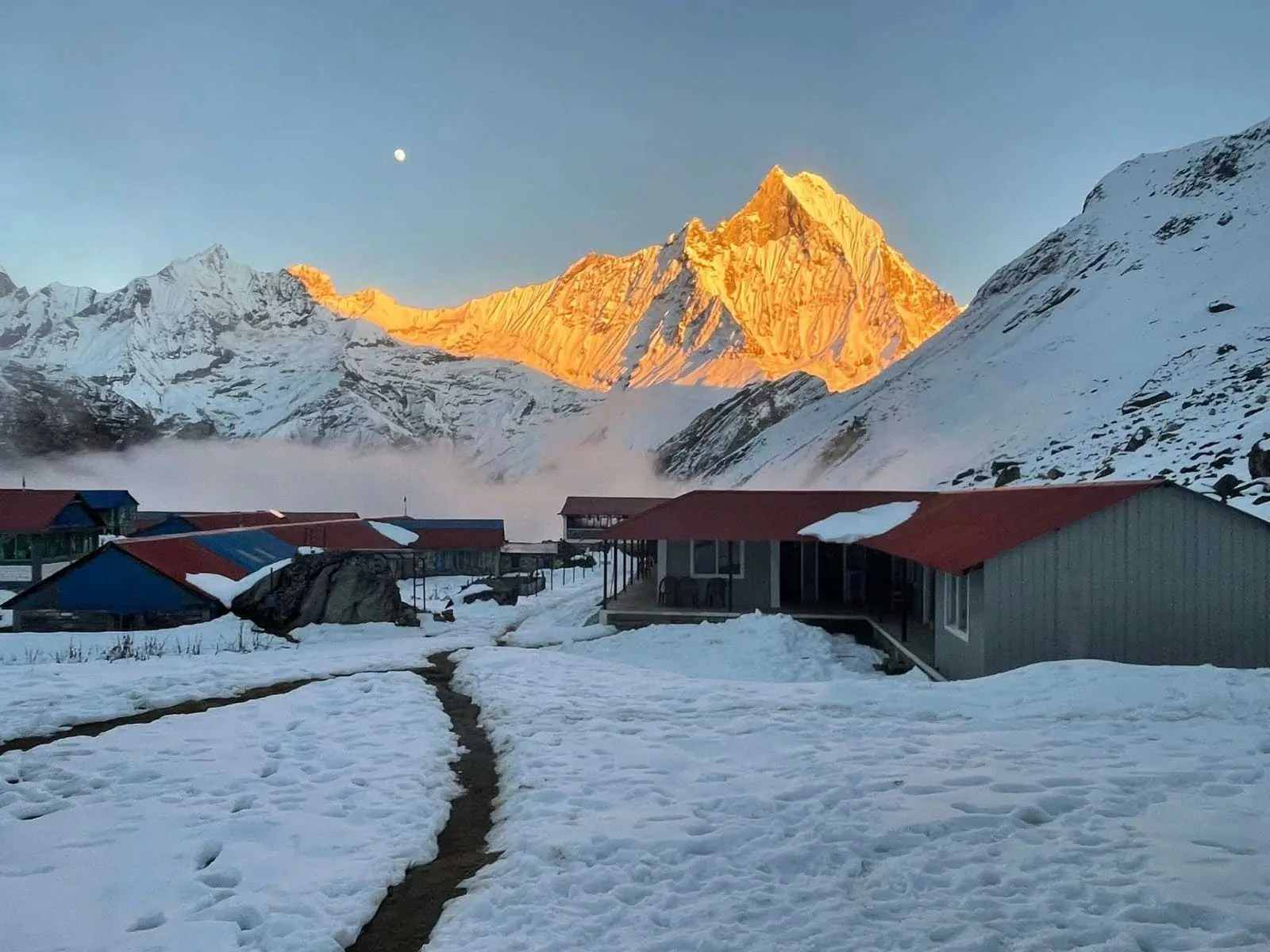
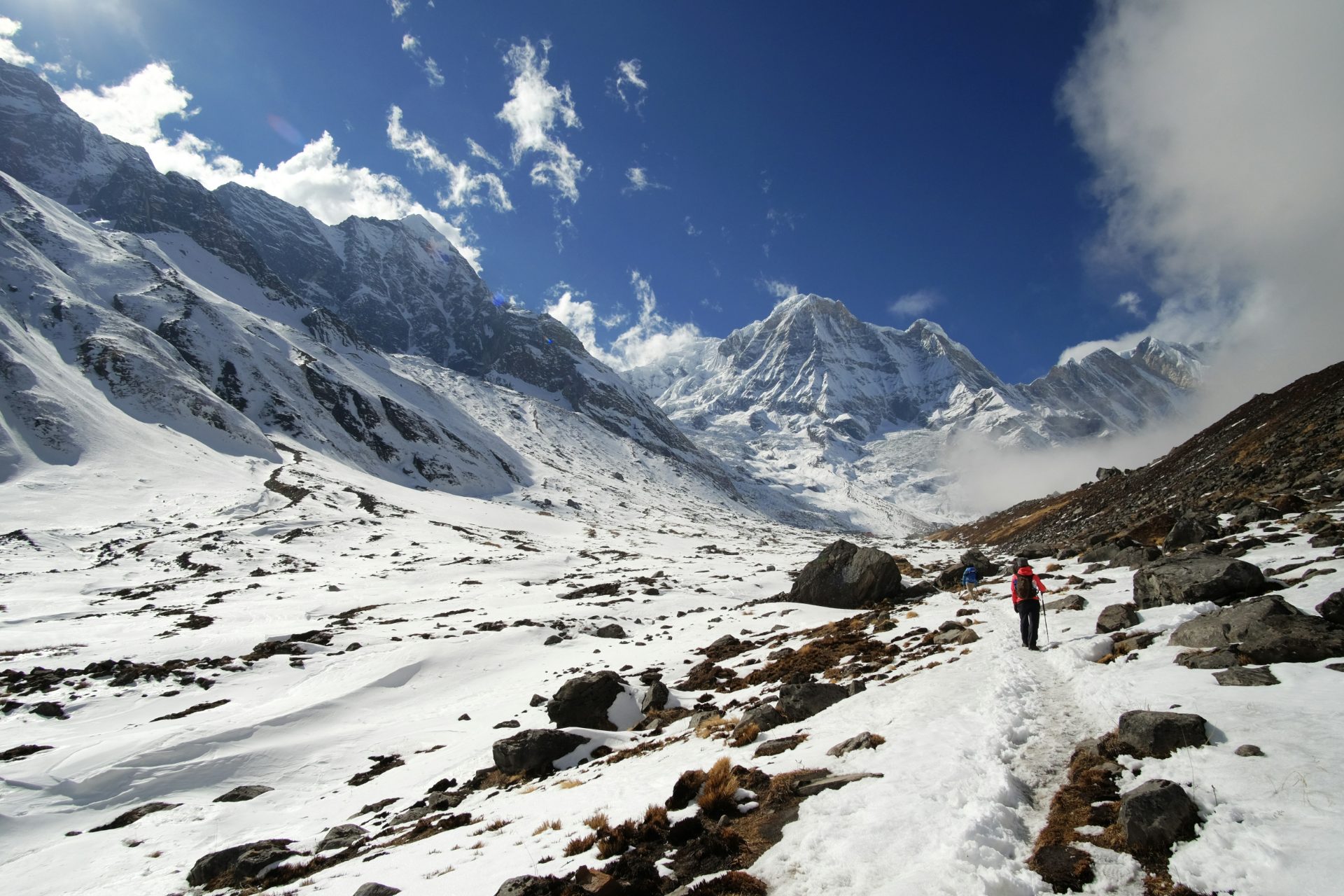
Trekking trails covered in fresh white snow leading up to Annapurna Base Camp.
The Annapurna Base Camp trek experiences four distinct seasons. Autumn (September to November) offers the clearest skies and stable conditions. Spring (March to May) brings rhododendron blooms and warmer days. Winter (December to February) is cold but quiet with crisp views. Monsoon (June to August) means heavy rain, leeches, and high avalanche risk.
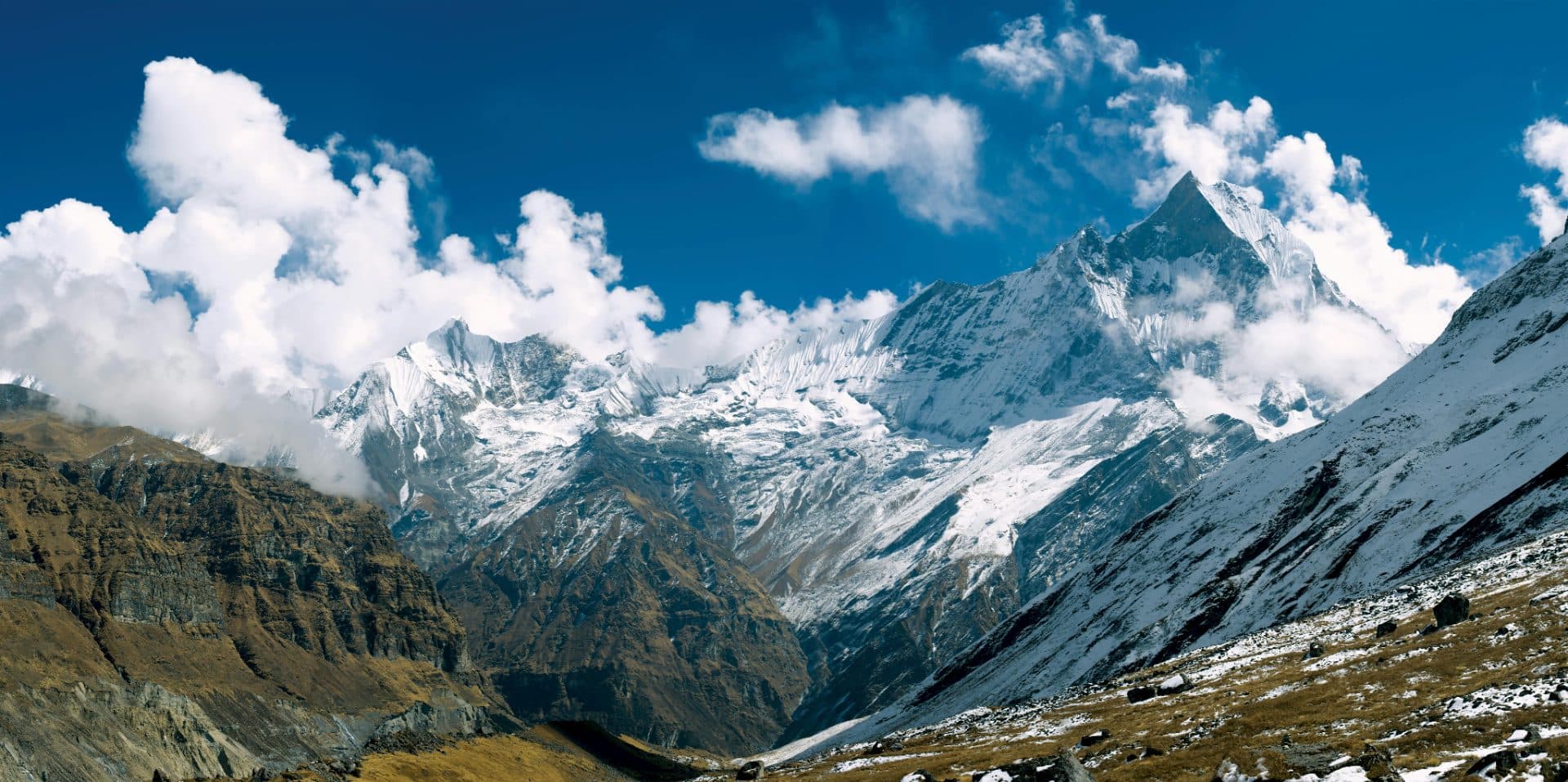
The Annapurna Sanctuary is a natural bowl ringed by giants like Annapurna I (8,091 meters), Hiunchuli, and Machhapuchhre. This geography traps moisture and creates microclimates. Mornings are typically clear, while clouds build by early afternoon, especially below 3,000 meters. We always tell our trekkers to be on the trail by sunrise to get the cleanest views.
The two prime windows for ABC are mid-September to late November and mid-March to mid-May. October delivers the most reliable visibility and dry trails. April is the peak month for rhododendron forests in full bloom between Ghandruk and Chhomrong. Both windows have stable freezing levels and predictable conditions above Deurali.
The ultimate guide to planning your dream web travel adventure with the experts from myeasyguide.
Spam free. Unsubscribe anytime. We respect your privacy.
Source: The Poetic Imagery
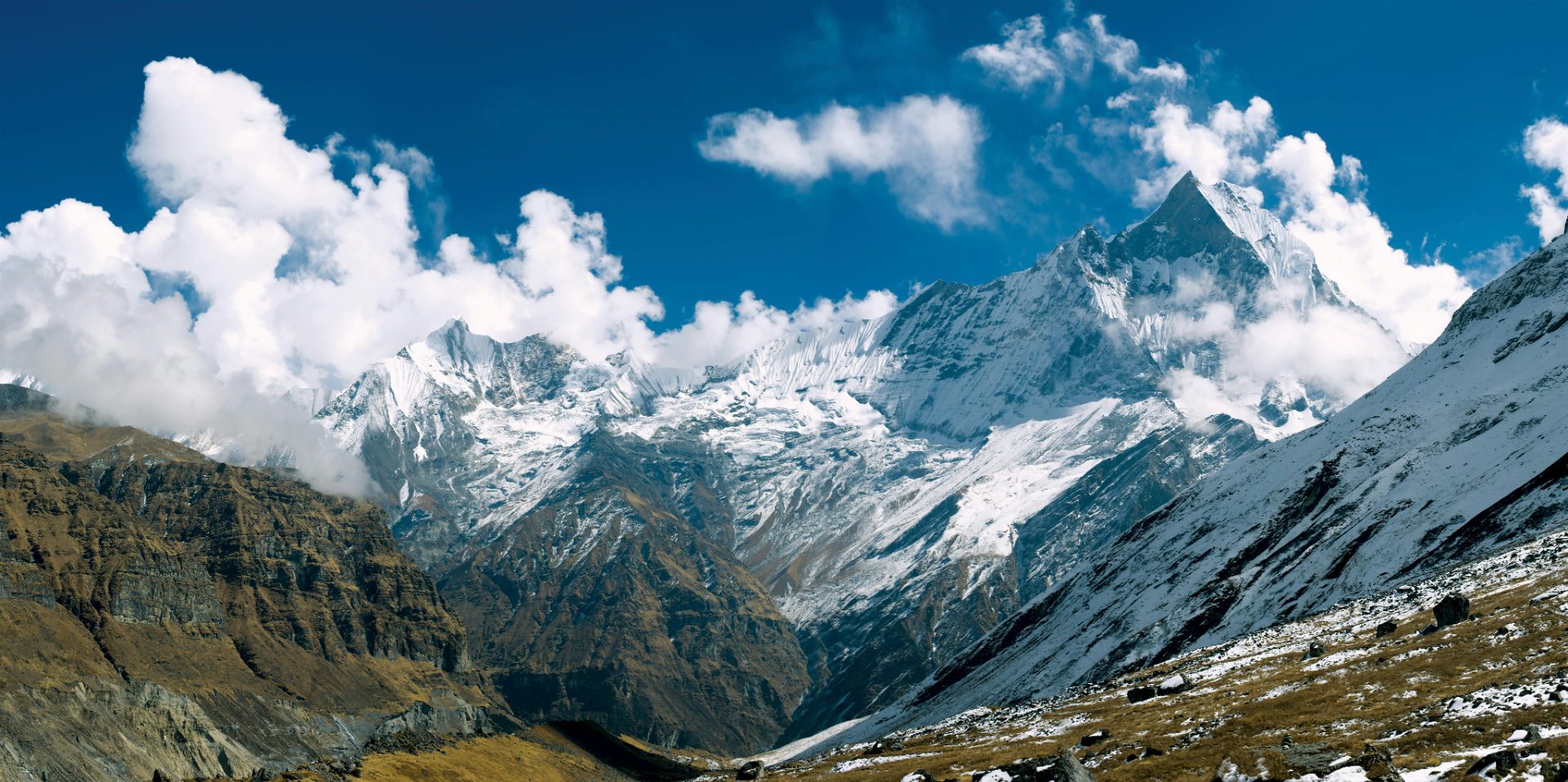
Clear blue skies and crisp mountain views at Annapurna Base Camp during the autumn trekking season.
Autumn is the most popular trekking window in Nepal. After the monsoon washes the dust away, the Annapurna massif appears in sharp definition for weeks at a time. Our field contacts report that mid-October through mid-November consistently delivers the cleanest sunrise views from MBC and ABC. Expect busy teahouses, so we always pre-book lodges at Chhomrong, Deurali, and MBC.
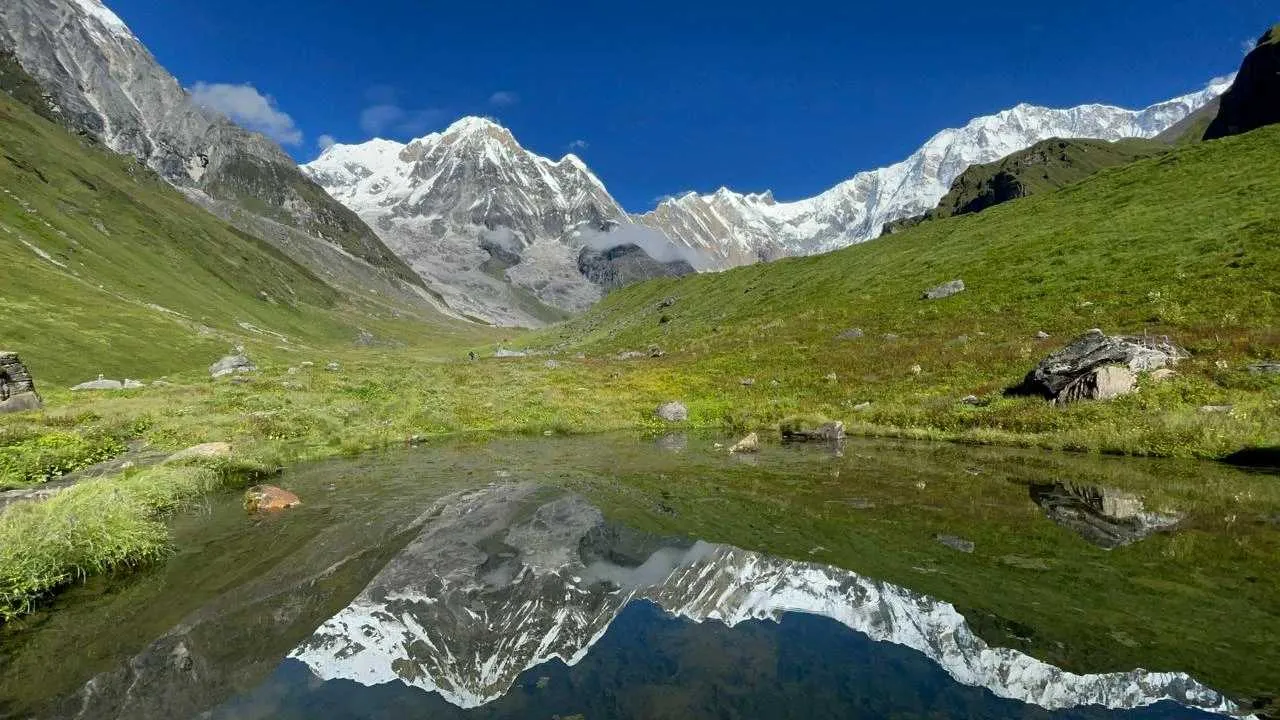
Greenery along the trail to Annapurna Base Camp in spring.
Spring is our personal favorite for the lower trail. The rhododendron forests between Ghorepani, Tadapani, and Chhomrong burst into red, pink, and white between late March and mid-April. Higher up, the trail can still hold snow in March, especially between Deurali and MBC. By May, pre-monsoon haze starts dulling distant views, so we recommend completing your trek by May 15.
Source: Redmaz Pham
Snow-capped mountain peaks surrounding a frozen Annapurna Base Camp sanctuary in winter.
Winter trekking to ABC is possible but demanding. Snow regularly blocks the trail above Deurali in January, and avalanche risk in the narrow gorge before MBC rises after fresh snowfall. Teahouses at MBC and ABC sometimes close or run with skeleton staff. If you go in winter, budget 2 extra buffer days for weather delays and hire a guide with recent winter route experience.
Source: Remi Jacquaint
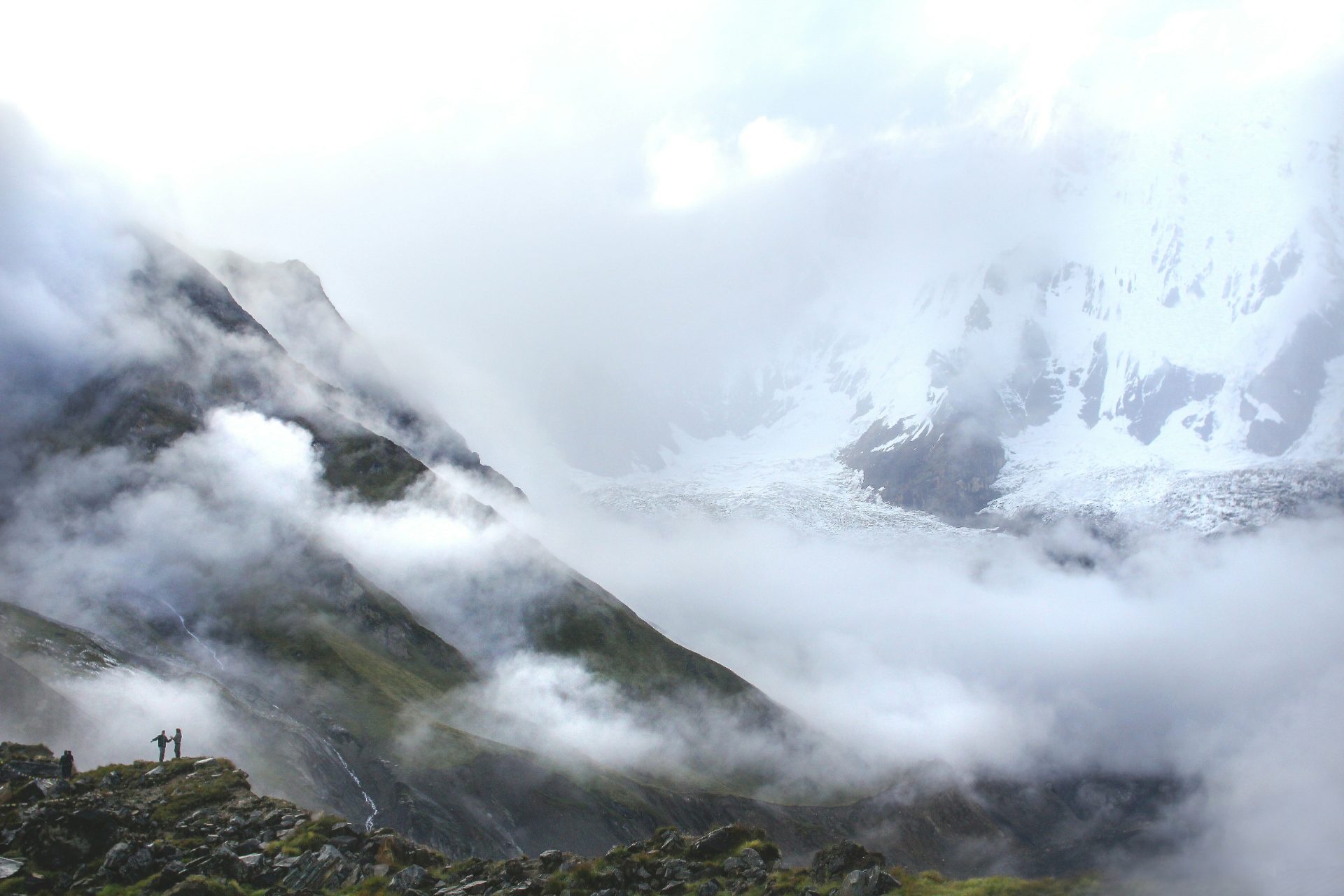
Misty, lush green valleys and dramatic clouds during a monsoon trek to Annapurna Base Camp.
We rarely recommend ABC during monsoon. Trails through Jhinu Danda and Bamboo become leech highways, landslides block the Modi Khola road sections, and afternoon thunderstorms make river crossings dangerous. If you have a fixed summer window for Himalayan trekking, point yourself toward Upper Mustang or Upper Dolpo instead. Both sit in the Himalayan rain shadow and stay dry while the rest of Nepal floods.
The Annapurna Base Camp trek requires two documents: the ACAP permit at NPR 3,000 per foreign trekker and the e-TIMS card at NPR 2,000. However, its enforcement in the Annapurna region is currently in flux, and many checkpoints are bypassing it entirely in favor of the ACAP permit.
While the "No Guide, No Trek" rule remains absolute (you must have a licensed guide to step on the trail), the Department of Immigration updated the rules on March 22, 2026, allowing individual solo foreign trekkers to apply for restricted area permits (like Upper Mustang or Manaslu) without needing a minimum group size of two.
Both permits are issued at the Nepal Tourism Board offices in Kathmandu or Pokhara. Your guiding agency handles this paperwork as part of the package. Bring two passport photos and a passport copy. Keep both permits accessible, there are checkpoints at Birethanti, Chhomrong, and sometimes Sinuwa.
Tourist visas at Tribhuvan International Airport in 2026 cost $30 USD for 15 days, $50 USD for 30 days, and $125 USD for 90 days. Pay in cash (USD preferred). The modern digital kiosks at Tribhuvan International Airport (TIA) scan passports and take digital photos directly at the machine. It is still wise to carry physical photos for trail permits.
The classic ABC route runs 7 to 12 days depending on your starting point and acclimatization strategy. Most trekkers begin from Nayapul or Siwai, climb through Ghandruk and Chhomrong, then enter the sanctuary via Bamboo, Deurali, MBC, and finally ABC. Daily walking ranges from 5 to 7 hours with significant stone-step elevation gain.
ABC is moderate altitude compared to Everest or Manaslu, but altitude sickness still happens. Above 3,000 meters, we never let our trekkers gain more than 300 to 500 meters of sleeping elevation per day. We typically build in a slow ascent through Sinuwa, Bamboo, Deurali, and MBC before pushing to ABC. Sleeping at MBC (3,700 meters) the night before final ascent is the safest approach.
Standard travel insurance does not cover Himalayan helicopter rescue. You need a policy that explicitly covers high-altitude evacuation up to 6,000 meters and treatment for AMS, HAPE, and HACE. A single chopper ride from ABC to Pokhara hospital can cost $3,000 to $5,000 USD. Bring printed proof of insurance — your guide may need to confirm coverage before authorizing a rescue.
ATMs end in Pokhara. There are no banking services past Nayapul. We tell trekkers to carry NPR 25,000 to 40,000 in mixed denominations. Ncell provides solid 4G coverage up to Deurali, while Nepal Telecom (NTC) works better in some pockets. Wi-Fi is available at most lodges for NPR 200 to 500, hot showers cost NPR 300 to 700, and charging a phone or power bank runs NPR 200 to 500 per device.
Layering is the entire philosophy of packing for ABC. You will experience temperatures from 25°C at Jhinu Danda to -15°C at the ABC viewpoint within 48 hours. Quality matters more than quantity — every gram you pack is carried on stone steps for days.
Skip the bottled water — single-use plastics are a major waste problem on this trail. Skip cotton clothing (it stays wet and kills warmth). Skip heavy books, drones (banned in ACAP without special permits), and large camera tripods unless you are a professional. Skip jeans and skip new boots you have not broken in.
Eat clean carbohydrates at altitude. We always recommend Dal Bhat — Nepal's traditional lentil soup, rice, and vegetable curry — for unlimited refills and clean energy. Avoid meat above Chhomrong; it is carried up unrefrigerated and is a common cause of stomach issues at altitude.
You will pass mani stones, chortens, and prayer wheels throughout the trek. Always walk to the left of these structures, keeping them on your right side. Spin prayer wheels clockwise. Remove shoes and hats before entering any monastery, and never photograph inside prayer halls without explicit permission from a resident monk.
Tipping is culturally expected and forms a meaningful part of your guide and porter's annual income. The marketplace standard is 15% to 20% of your total trek cost, distributed at the end of the trek. We suggest roughly $10-15 USD per day for guides and $7-10 USD per day for porters as a working baseline.
Three avoidable errors derail ABC treks every year. First, trekkers underestimate the stone-step descent from Chhomrong, which destroys knees. Bring trekking poles. Second, trekkers ascend too fast from Bamboo to ABC in two days and develop AMS. Take three. Third, trekkers buy plastic water bottles and run out of cash for hot showers and Wi-Fi by Deurali.
ABC is one of the most rewarding mid-altitude treks on the planet — and one of the most underestimated. The weather window you choose shapes everything: your views, your comfort, your crowd levels, and your safety margin. Pick October or April if you want the highest probability of clear skies. Pick November or March if you want fewer crowds without sacrificing visibility. Whatever month you choose, pack for layering, carry cash, and trek with a guide who knows the Modi Khola valley intimately.
No. As of April 2023 and reaffirmed under 2026 Nepal Tourism Board rules, all trekkers in the Annapurna Conservation Area must hire a licensed guide. Solo trekking is no longer permitted on the ABC route, and checkpoints at Chhomrong actively verify guide credentials.
At 4,130 meters, nighttime temperatures at ABC drop to -15°C to -10°C in December and January, and around -5°C to 0°C in peak autumn and spring. Daytime warms quickly when the sun clears the ridgeline.
Yes. Most teahouses offer paid Wi-Fi for NPR 200 to 500 per session. Ncell mobile data works reliably up to Deurali, with patchy reception at MBC and ABC.
Technically yes, but we do not recommend it. Trails are slippery, leeches are abundant in the lower forests, and avalanche risk in the Hinku Cave to MBC section increases significantly. Mountain views are often blocked by clouds for days at a time.
Carry NPR 25,000 to 40,000 per person depending on trek length and personal spending habits. ATMs end at Pokhara, and trail upcharges for hot showers, device charging, Wi-Fi, and bottled drinks add up faster than most trekkers expect.
From late December through early March, yes. Microspikes are usually sufficient for the icy patches between Deurali and ABC. Your guide will advise based on recent conditions, and rentals are available in Pokhara for around NPR 300-500 per day.