Asmita Karki
The Mardi Himal trek hides in plain sight. It runs parallel to the famous Annapurna Sanctuary route, yet most international trekkers we meet in Pokhara have never heard the name until a guide mentions it. The reason it deserves more attention has everything to do with altitude, specifically, how this trek compresses a serious Himalayan elevation gain into a short, manageable window without crossing into extreme oxygen-thin territory.
Our field coordinators have walked this ridge in every season, and we've watched the trail evolve from a rough shepherd's path into one of the Annapurna region's most rewarding short treks. Here's everything you need to know about the altitude, the acclimatization strategy, and the daily realities of reaching Mardi Himal Base Camp at 4,500 meters.
Source: Mardi Trek
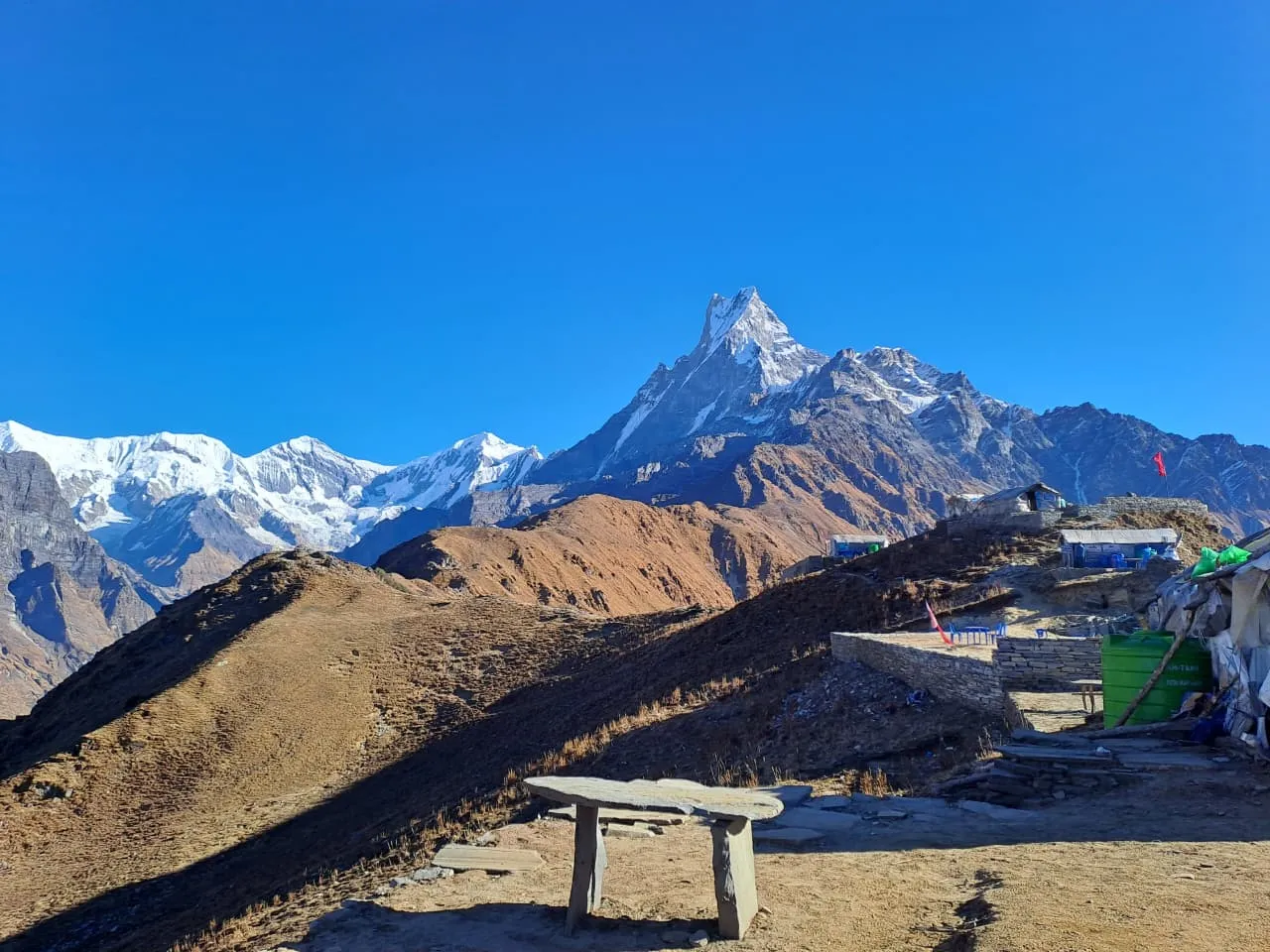
Narrow ridge path toward Mardi Himal High Camp with Machapuchare peak behind.
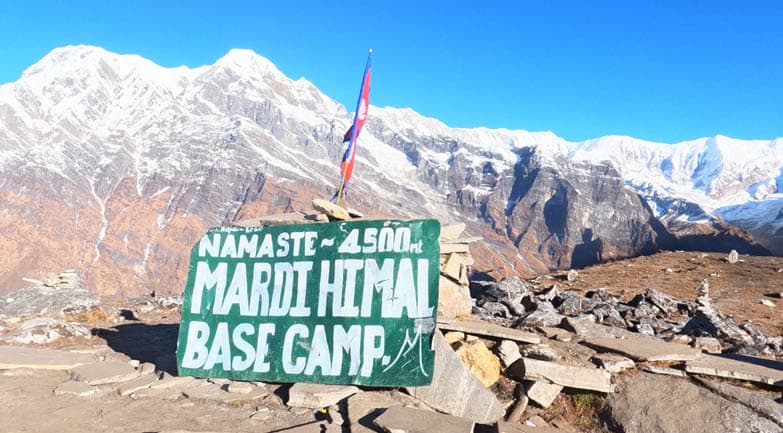
Mardi Himal Base Camp sits at 4,500 meters (14,763 feet) on a glacial moraine beneath Mardi Himal peak (5,587m). The trek's more popular photography spot, the Upper Viewpoint, is at 4,200 meters. High Camp, the typical sleeping point before the final ascent, is at 3,580 meters. The trail starts near Kande village at just 1,770 meters.
This elevation profile matters because it sits in what we call the "middle zone" of Himalayan trekking. You're well above the 3,000-meter threshold where AMS becomes a real concern, but you stay below the 5,000 meter mark where supplemental safety planning becomes critical. That doesn't mean it's risk-free.
The trek follows a steep wooded ridge that climbs rapidly through rhododendron and oak forest before emerging onto the alpine grassland above the treeline. Understanding the daily gain helps you spot where AMS pressure builds.
Day | Route Segment | Sleeping Altitude | Elevation Gain |
1 | Pokhara → Kande → Forest Camp | 2,520 m | +980 m |
2 | Forest Camp → Low Camp | 2,970 m | +450 m |
3 | Low Camp → High Camp | 3,580 m | +610 m |
4 | High Camp → Base Camp → High Camp | 3,580 m | +920 m / -920 m |
5 | High Camp → Siding Village | 1,750 m | -1,830 m |
6 | Siding → Pokhara | 820 m | -930 m |
Look closely at Day 3 to 4. That's a sleeping-altitude gain of 610 meters followed the next morning by a daytime push of nearly 920 meters. This exceeds the standard safe acclimatization rule of 300-500 meters per day in sleeping elevation above 3,000m. The reason it usually works is that you descend back to High Camp to sleep but trekkers who skip the buffer night at Forest Camp or Low Camp routinely hit AMS symptoms at High Camp.
The safest Mardi Himal itinerary spreads the ascent over 6-7 days and includes either a slow night at Forest Camp or a second night at Low Camp. Walk slowly, drink at least 3-4 liters of water daily, and ascend to Base Camp early in the morning so you can descend before afternoon weather rolls in.
The classic mountaineering principle applies perfectly here. From High Camp at 3,580m, you make a round trip to Upper Viewpoint or Base Camp during the day and return to sleep lower. This lets your body experience the higher altitude without the prolonged exposure that triggers serious AMS during sleep.
We see the same symptoms repeat among trekkers each season at High Camp:
If symptoms worsen beyond mild discomfort, the rule is non-negotiable: descend immediately. Sliding back down to Low Camp at 2,970m usually resolves moderate AMS within hours.
Standard travel insurance does not cover Himalayan trekking. You need a policy that explicitly covers high-altitude emergency helicopter evacuation up to 6,000m and medical treatment for AMS, HAPE, and HACE. Helicopter evacuation from High Camp to Pokhara hospital can cost $3,000-5,000 USD without coverage. Confirm your policy in writing before flying to Kathmandu.
Two permits are mandatory for Mardi Himal Base Camp: the Annapurna Conservation Area Permit (ACAP) at NPR 3,000 and the e-TIMS card at NPR 2,000. As of 2023 and reinforced in 2026, foreign trekkers must hire a government-licensed guide for all Annapurna trails, including Mardi Himal.
The solo trekking option is closed. The Nepal Tourism Board enforces this through ACAP checkpoints at Dhampus Phedi and Forest Camp, where rangers verify both your permit and your guide's license number. Trying to slip through without a guide will get you turned back at the first checkpoint and refunded nothing.
Your tourist visa cost depends on duration: $30 USD for 15 days, $50 USD for 30 days, and $125 USD for 90 days on arrival at Tribhuvan International Airport.
Source: Nepal Everest Guide
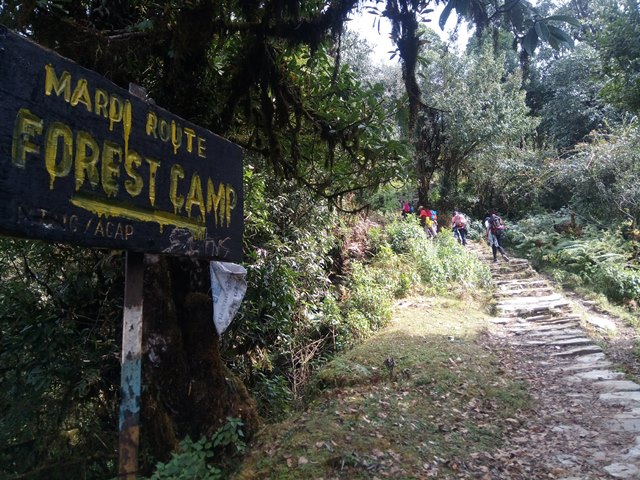
Rustic wooden sign board at Forest Camp along the forested Mardi Himal trek route.
The first two days move through one of the densest rhododendron forests in the Annapurna region. In March and April, the canopy bursts into red, pink, and white blossoms. The trail is steep, narrow, and root-laced. You'll hear langur monkeys crashing through the upper canopy and the persistent call of Himalayan thrushes.
This zone, between 2,500m and 3,000m, is biologically rich but slippery during monsoon. Leeches are aggressive between June and August on this section.
Source: Life Himalaya Trekking
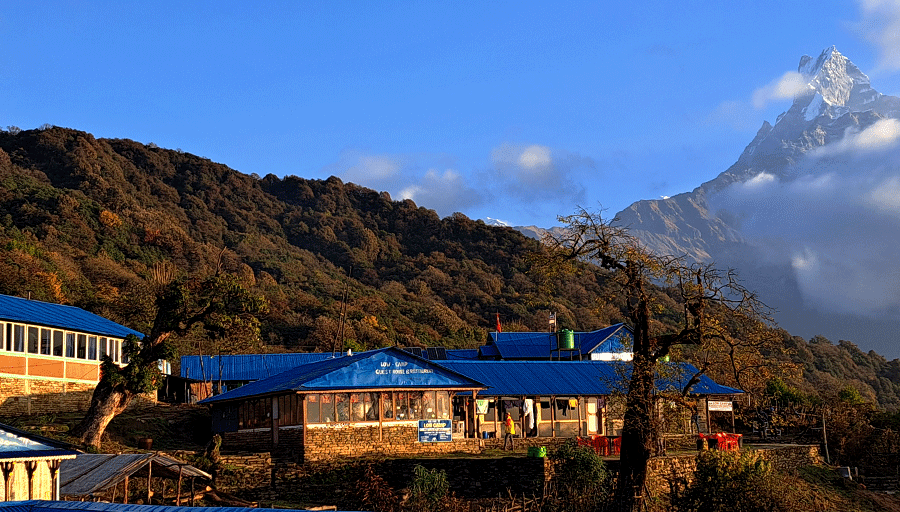
Cozy mountain lodges at Low Camp on the Mardi Himal ridge trail, surrounded by mist and trees.
The transition happens almost suddenly. The forest thins to dwarf rhododendron, then opens into a high ridgeline with the entire Annapurna massif rising to your left. Machapuchare (Fishtail, 6,993m) dominates the view directly ahead. The trail narrows to a knife-edge in places with steep drops on either side, this is where altitude and exposure combine, and where most trekkers slow noticeably.
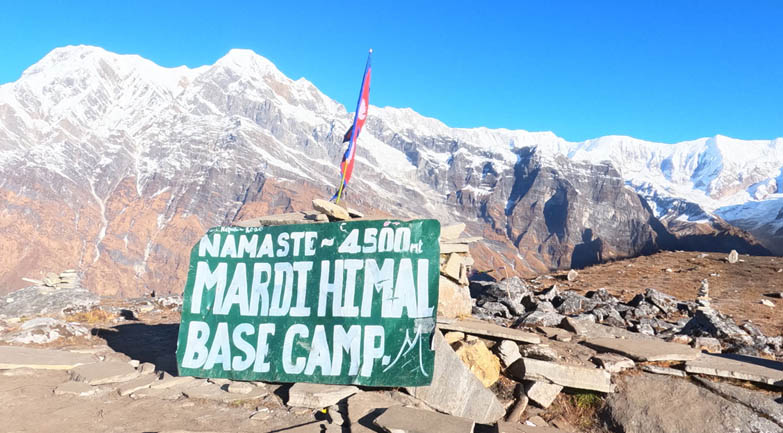
Source: Nepal Travel Adventure
Dramatic panoramic view of Annapurna range from Mardi Himal Base Camp.
From High Camp, the climb to Upper Viewpoint takes around 2 hours. Continuing to Base Camp adds another 2-3 hours across rocky moraine. The terrain becomes loose scree, and the wind picks up substantially. Start by 4:30 AM to reach Base Camp before clouds close in by 11 AM, the view often vanishes entirely.
Season | Months | Conditions |
Autumn | Late Sept–Nov | Best visibility, stable weather, busiest trails |
Spring | March–May | Rhododendron bloom, warmer nights, hazy afternoons |
Winter | Dec–Feb | Heavy snow at High Camp, many lodges close |
Monsoon | June–Aug | Leeches, slippery trails, limited views |
For altitude comfort specifically, autumn delivers the most stable atmospheric conditions. Cold mornings actually help lower temperatures correlate with higher oxygen saturation in the air.
There are no ATMs anywhere on the Mardi Himal trail. Withdraw all your trek cash in Pokhara before departure. Expect to spend NPR 2,500-4,000 per day on food and lodging at the higher camps, where everything must be carried up by porter.
Common upcharges at Low Camp and above:
For cellular coverage, Ncell works reliably up to Low Camp and intermittently at High Camp. Nepal Telecom (NTC) performs better above the treeline near Base Camp. We recommend buying a tourist SIM at Kathmandu airport for around NPR 1,000-1,500 with data.
Stick to vegetarian meals on this trek. Meat carried up by porter without refrigeration is a real risk for food poisoning, which at altitude can mimic or worsen AMS symptoms. The lodge staple, Dal Bhat (lentil soup, rice, vegetable curry, and pickles) comes with free refills and provides the clean carbohydrate fuel your body needs above 3,000m.
Skip bottled water. Carry a reusable bottle paired with a UV purifier (SteriPen), Sawyer squeeze filter, or chlorine dioxide tablets. Plastic bottles cost up to NPR 400 at High Camp and contribute heavily to trail waste that locals must carry back down.
The Mardi Himal trail passes through small Gurung and Magar settlements, particularly around Siding and Lwang on the descent route. When you encounter mani stones, prayer flags, or small chortens along the high ridge, pass them on the left so the structure stays on your right side. Walk clockwise around any stupa.
If you visit a monastery or shrine, remove shoes and hats before entering. Photography inside prayer halls is prohibited unless a resident monk explicitly permits it.
Tipping is culturally expected and is a significant portion of guide and porter income. The marketplace standard is 15%-20% of total trek cost, distributed among the crew at the end of the trek. For a typical 6-day Mardi Himal trek, this usually translates to around $80-120 USD for the guide and $60-90 USD per porter, handed over personally on the final evening.
Yes, considerably. Poon Hill tops out at 3,210m, while Mardi Himal Base Camp sits at 4,500m. The trail to Mardi is steeper, the ridgeline more exposed, and the altitude risk meaningfully higher. Poon Hill suits first-time trekkers; Mardi suits those with moderate hiking fitness ready for a real Himalayan ascent.
Yes, but only with a 6-7 day itinerary that allows proper acclimatization. Beginners attempting the aggressive 4-5 day version often experience AMS at High Camp. We recommend at least 2-3 months of cardio training and stair-climbing preparation before departure.
From November through March, microspikes are strongly recommended for the icy sections above Low Camp. Full crampons and ice axes are not needed on the standard route — the trail to Base Camp is a walking path, not a climbing route.
Night temperatures at High Camp drop to -5°C to -15°C from late November through February. In peak autumn and spring, expect 0°C to -5°C overnight. Carry a sleeping bag rated to at least -10°C comfort, even in shoulder seasons.
Yes. Experienced trekkers sometimes link the two trails via Landruk village, creating a 10-12 day combined route. This works best in autumn when both trails are dry and stable.
No, there is no Wi-Fi at Base Camp itself. Most lodges from Low Camp upward offer paid Wi-Fi at NPR 300-500 per session, but signal quality is unreliable. Cellular data via NTC works at parts of High Camp and intermittently near the Upper Viewpoint.
Mardi Himal rewards trekkers who respect the altitude. The trail's beauty, that knife-edge ridge above the clouds with Machapuchare close enough to feel is real, but so is the rapid elevation gain. Walking this route with a licensed local guide isn't just regulation; it's the difference between a memorable trek and a medical emergency.
Our marketplace connects you directly with vetted, government-licensed Pokhara-based guides who walk these ridges every season. Browse tailored Mardi Himal itineraries, compare crew pricing transparently, and message guides directly to customize your acclimatization schedule before you book.
The ultimate guide to planning your dream web travel adventure with the experts from myeasyguide.
Spam free. Unsubscribe anytime. We respect your privacy.